This is the start of a series of posts on my first time teaching an introductory legal and constitutional history course. Guest blogger Anders Walker has covered this ground before, and I hope readers continue to benefit from his terrific posts (here). We ought to revisit this topic regularly, as pedagogical methods change, the field shifts, and the appetite for legal history waxes and wanes.
Some of my comments will be specific to teaching legal history in a law school setting, but I hope the conversation will extend to courses taught at the undergraduate and graduate level in history departments. I imagine that my law school course is not in fact so different from an undergraduate level survey. For example, I taught in lecture format and did not assume a strong background in U.S. history. The main differences seem to be the assignments (one final exam/paper as opposed to various projects and shorter papers over the course of the semester) and my operating assumptions about the students' knowledge of legal doctrine and legal institutions.
First, the syllabus. For all you first-time legal history teachers, there are a few great collections of legal history syllabi on the web: check out the links on H-Law, here, and on the Triangle Legal History Seminar's website, here. Anders Walker's syllabus is here, on SSRN. (To those of you who have contributed to these syllabi banks -- thank you!) I also emailed a few legal historians whom I admire, and without fail, they were very generous about sharing with me.
My syllabus is shamelessly derivative of the "Legal History: Law in American Life" course that Sarah Barringer Gordon teaches at the University of Pennsylvania School of Law, but I revised a bit to reflect my strengths and interests, as well as to take into account student feedback (e.g., they voted for "Law and the 'War on Terror'" for the final week). I'm sure I will continue to tweak this syllabus, but for the purposes of discussion, here it is:
Read more »
The U.S. Legal History Survey Revisited: I
.
Labels:
Teaching
Lederman and Purcell to Lead ICH Seminar on War Powers
[We are moving these two announcements up as the deadline of May 15 is approaching.]
The Institute for Constitutional History has announced another Robert H. Smith seminar for advanced graduate students and junior faculty. This one is “Modern Constitutional War Powers.” One of the instructors is my colleague Martin S. Lederman, an Associate Professor of Law at the Georgetown University Law Center, who served as Deputy Assistant Attorney General in the Department of Justice's Office of Legal Counsel from 2009 to 2010, and an Attorney Advisor in OLC from 1994-2002. The other is Edward A. Purcell, Jr., the Joseph Solomon Distinguished Professor at New York Law School and one of the nation's foremost authorities on the history of the United States Supreme Court and the federal judicial system. He is the author of several books, including Originalism, Federalism, and the American Constitutional Enterprise: A Historical Inquiry (Yale University Press, 2007), and Brandeis and the Progressive Constitution: Erie, the Judicial Power, and the Politics of the Federal Courts in Twentieth-Century America (Yale University Press, 2000).
The ICH folks explain:
The six-week seminar concerns the evolution of the distribution of war powers from the beginning of the Twentieth Century to the present day. The Founders endeavored to create a federal system in which a separation and blending of powers would make the legislature the preeminent source of military authority and thus prevent the executive from unilaterally entangling the nation in costly belligerent adventures. Conventional wisdom has it that practical developments over the past 100 years-most significantly, the creation of a powerful standing army and intelligence establishment, the development of nuclear weapons, and the emergence of a much more robust role for the United States as a superpower responsible for the defense of Europe and other allies in a post-nuclear age-have rendered the original constitutional design obsolete, such that Congress and the courts have largely ceded war-making authority to an all-powerful, virtually unchecked President. In this interdisciplinary course, using conventional legal materials as well as recent historical and political science accounts of the distribution of war powers, we will examine whether and to what extent this conventional account is accurate, and will more broadly discuss whether the current balance of powers ensures sufficient checks on misguided adventurism and abuse of individual liberties.The seminars will take place from 3:00 to 5:00 at the New-York Historical Society, 170 Central Park West, New York City on the following Wednesday afternoons:October 16, 23, 30, November 6, 13, 20. There is no tuition or other charge for this seminar, though participants will be expected to acquire the assigned books on their own.
Read more » (Read More..)
Levinson to Lead ICH Seminar, "Assessing the U.S. Constitution"
.
[We are moving these two announcements up as the deadline of May 15 is approaching.]
The Institute for Constitutional History announces another Robert H. Smith seminar for advanced graduate students and junior faculty. This one is "Assessing the U.S. Constitution: Twenty-First-Century Responses to Eighteenth-Century Assumptions." It is to be led by Sanford Levinson, the W. St. John Garwood Jr. Centennial Chair in Law, University of Texas Law School, and Professor of Government, University of Texas at Austin. Our friends at the ICH explain:
The seminar will meet Thursday evenings, 6:00-8:00 p.m., September 12, 19, October 3, 10, 24, and November 7 at The George Washington University Law School, 2000 H Street NW, Washington, DC 20052.The United States Constitution was drafted at least in part under the sway of particular conceptions of government and politics (putting entirely to one side the role that out-and-out political bargaining played at the Philadelphia Convention). This seminar will examine some of these central assumptions, particularly concerning the nature of what the Constitution itself calls a "Republican Form of Government" and ask to what degree we-or, more accurately, you as students within the seminar-agree in 2013 with the assumption set out, often with both candor and eloquence, in 1787-88. Course materials will be drawn almost entirely from primary sources, including materials collected in Philip Kurland and Ralph Lerner, eds., The Founder’s Constitution and The Federalist, though it is also likely that Professor Levinson's recent book Framed: America's 51 Constitutions and the Crisis of Governance will also be assigned. Reading will not be particularly heavy in quantity, but the assumption is that what is assigned will be read and then discussed quite intensely.
Further:
The seminar is designed for graduate students and junior faculty in history, political science, law, and related disciplines. All participants will be expected to complete the assigned readings and participate in seminar discussions. Although the Institute cannot offer academic credit directly for the seminar, students may be able to earn graduate credit through their home departments by completing an independent research project in conjunction with the seminar. Please consult with your advisor and/or director of graduate studies about these possibilities. Space is limited, so applicants should send a copy of their c.v. and a short statement on how this seminar will be useful to them in their research, teaching, or professional development. Materials will be accepted only by email at MMarcus@nyhistory.org until May 15, 2013. Successful applicants will be notified soon thereafter. For further information, please contact Maeva Marcus at (202) 994-6562 or send an email to MMarcus@nyhistory.org.
There is no tuition or other charge for this seminar, though participants will be expected to acquire the assigned books on their own.(Read More..)
More on the Blackwell Companion to American Legal History
.
Labels:
Scholarship -- Books
Yesterday we spotlighted the new Blackwell Companion to American Legal History. Alfred L. Brophy (University of North Carolina), one of the editors, has posted some thoughts about the volume here, at the Faculty Lounge. Here's a taste:
I think the volume comes at precisely the right moment for American legal history, because the field is going in so many different directions at once. A while back -- like when I was in graduate school -- the field was still dominated by studies of appellate opinions and jurisprudence. So judges, treatise writers, and high brow legal thinkers predominated in the field. There has been an extraordinary expansion in subjects over the past several decades. Legal historians are looking closely at enslaved people, women, gay people, immigrants, workers, welfare recipients, as well as lawyers in big firms and small. And they're looking at the procedures of justice of the peace and police courts, local trial courts, as well as state supreme courts and the United States Supreme Court. The methods have broadened dramatically, too: we're interested in how fictional literature critiqued law (and in some cases supported it); how the technology of law brought down irrational authority and (more commonly) supported it. As Sally and I say in the introduction -- and as I've observed elsewhere -- legal history is expanding so much in subjects and methods that it is beginning to look like almost all of history fits somewhere in its boundaries.
There's just a lot of literature to deal with and a great many moving parts. Most of this is positive -- it's great to be in such a broad field. One thing, however, is negative here. And that is that the field is going in search of unifying principles. . . .Read on here. (Read More..)
Trade and Legal Pluralism in the Era of the Geniza
.
Labels:
Conferences and Calls for Papers,
Medieval law,
Middle East
The Fourth Berg International Conference, In-Between: Trade and Legal Pluralism in the Era of the Geniza, will be convened by the Tel Aviv University Faculty of Law, May 29-31, 2013. The organizers explain,
The conference is devoted to the study of the legal history of medieval trade, mainly based on the Cairo Geniza documents, but also dealing with other pre-modern contexts. It brings together many of the leading legal, social and economic historians of medieval Jewish trade and its law as well as leading global experts of the history of other medieval and early modern trade law systems.Program and further information here. (Read More..)
Cummings's "Democracy of Sound"
Alex Sayf Cummings, an assistant professor in the Department of History at Georgia State University, has recently published Democracy of Sound: Music Piracy and the Remaking of American Copyright in the Twentieth Century (Oxford University Press). Saith the Press:
Here’s a blurb that matters:It was a time when music fans copied and traded recordings without permission. An outraged music industry pushed Congress to pass anti-piracy legislation. Yes, that time is now; it was also the era of Napster in the 1990s, of cassette tapes in the 1970s, of reel-to-reel tapes in the 1950s, even the phonograph epoch of the 1930s. Piracy, it turns out, is as old as recorded music itself.
In Democracy of Sound, Alex Sayf Cummings uncovers the little-known history of music piracy and its sweeping effects on the definition of copyright in the United States. When copyright emerged, only visual material such as books and maps were thought to deserve protection; even musical compositions were not included until 1831. Once a performance could be captured on a wax cylinder or vinyl disc, profound questions arose over the meaning of intellectual property. Is only a written composition defined as a piece of art? If a singer performs a different interpretation of a song, is it a new and distinct work? Such questions have only grown more pressing with the rise of sampling and other forms of musical pastiche. Indeed, music has become the prime battleground between piracy and copyright. It is compact, making it easy to copy. And it is highly social, shared or traded through social networks--often networks that arise around music itself. But such networks also pose a counter-argument: as channels for copying and sharing sounds, they were instrumental in nourishing hip-hop and other new forms of music central to American culture today. Piracy is not always a bad thing.
An insightful and often entertaining look at the history of music piracy, Democracy of Sound offers invaluable background to one of the hot-button issues involving creativity and the law.
"Beautifully crafted, intelligently researched, and cogently argued, Democracy of Sound offers readers a compelling analysis of the changing legal status of recorded music in the United States from the 1870s to the present. Many books have been written about intellectual property; few have done more to make its significance accessible to the general reader. It will appeal not only to specialists in American studies, music, and law, but also to anyone who cares about American popular culture, past and present." --Richard John, author of Network Nation (Read More..)
Hutchinson on Revising the Lochner Revisionists
Harry G. Hutchison, George Mason University School of Law, has posted Lochner, Liberty of Contract and Paternalism: Revising the Revisionists? which is forthcoming in volume 47 of the Indiana Law Review. Here is the abstract:
Given the resilience of the opposition to the liberty of contract jurisprudence, a doctrine that is epitomized by Lochner, and given the insistent dedication of scholars and jurists to a largely mistaken understanding of economic substantive due process argumentation, it is an appropriate time to review David Mayer’s contribution to the literature surrounding Lochner. In his new book, "Liberty Of Contract: Rediscovering A Lost Constitutional Right", Mayer rightly contends that the Court, during the Lochner era, was protecting liberty of contract as a fundamental right rather than enacting laissez-faire constitutionalism as Justice Holmes and his intellectual heirs supposed. Building upon Professor Sawyer’s exposition of Hammer and its origins in the mind of one of America’s most influential legal theorists, Philander Knox, I offer a contrasting conception of the Lochner Court. This conception implies that the Supreme Court’s decision making during the Lochner era corresponds with the Court and the nation’s capitulation to progressive values. Given Sawyer’s analysis, I argue that Mayer’s bracing defense of liberty of contract jurisprudence is diminished by analytical gaps that fail to satisfactorily account for the history and potency of the social, cultural and quasi-scientific currents permeating the nation before, during and after the onset of the Lochner era. This Article shows, notwithstanding the elegance of liberty of contract jurisprudence, that the emergence of today’s welfare state resembling a dystopian reality that richly manifests itself in legions of “one percenters,” who insist on occupying America’s capital city, was an unfortunate, but predictable, outcome. Finally, I contend that until citizens, politicians and judges display modesty about the nation’s capacity to solve the human problem and immodesty about an individual’s right and responsibility to solve her own difficulties in voluntary communion with others, it remains doubtful that the rediscovery of liberty of contract as a lost constitutional right can become anything but an attractive anachronism.(Read More..)
New Release: Blackwell Companion to American Legal History
.
Labels:
Scholarship -- Books
The much-anticipated Blackwell Companion to American Legal History, edited by Sally E. Hadden (Western Michigan University) and Alfred L. Brophy (University of North Carolina), is now out in the world. Here's the Table of Contents:

Introduction 1Read more » (Read More..)
Sally E. Hadden and Alfred L. Brophy
Part I Chronological Overviews 5
1 Reconsidering the Seventeenth Century: Legal History in the Americas 7
Elizabeth Dale
2 What’s Done and Undone: Colonial American Legal History, 1700−1775 26
Sally E. Hadden
3 1775−1815 46
Ellen Holmes Pearson
4 The Antebellum Era Through Civil War 67
Alfred L. Brophy
5 Beyond Classical Legal Thought: Law and Governance in Postbellum America, 1865−1920 86
Roman J. Hoyos
6 American Legal History, 1920−1970 105
Christopher W. Schmidt
Part II Individuals and Groups 125
7 Native Americans 127
Christian McMillen
8 African Americans in Slavery 152
Thomas J. Davis
9 African Americans in Freedom 171
James Campbell
10 Women’s Legal History 190
Felice Batlan
11 Families 209
David S. Tanenhaus
12 Who Belongs? Immigrants and the Law in American History 228
Allison Brownell Tirres
13 The Legal Profession 247
Mark E. Steiner
Part III Subject Areas 267
14 Law and the Economy of Early America: Markets, Institutions of Exchange, and Labor 269
Christine Desan
15 Law and the Economy in the United States, 1820−2000 289
Harwell Wells
16 Law and Labor in the Nineteenth and Twentieth Centuries 308
Deborah Dinner
17 Siting the Legal History of Poverty: Below, Above, and Amidst 329
Felicia Kornbluh and Karen Tani
18 Taxes 349
Robin L. Einhorn
19 Law and the Administrative State 367
Joanna L. Grisinger
20 Law and Religion 387
Steven K. Green
21 Legal History and the Military 406
Elizabeth L. Hillman
22 Criminal Law and Justice in America 422
Elizabeth Dale
23 Intellectual Property 441
Steven Wilf
Part IV Legal Thought 461
24 Law and Literature 463
Jeannine Marie DeLombard
25 Legal Thought from Blackstone to Kent and Story 484
Steven J. Macias
26 American Jurisprudence in the Nineteenth and Early Twentieth Centuries 506
James D. Schmidt
27 Critical Legal Studies 524
John Henry Schlegel
28 The International Context: An Imperial Perspective on American Legal History 543
Clara Altman
Maveal reviews Woeste's "Henry Ford's War on Jews"
.
Labels:
Scholarship -- Books
Gary Maveal, University of Detroit Mercy School of Law, reviews Victoria Saker Woeste’s Henry Ford's War on Jews and the Legal Battle Against Hate Speech (Stanford University Press, 2012) in 92 Michigan Bar Journal 54 (February 2013), which is to say, here.
(Read More..)Lawyers in the WPA's Life Histories Collection
.
Labels:
Archives and Web Resources,
Legal profession
Particularly at the end of the semester, with paper drafts to read and exams to write and grade, one can easily think of teaching and research as a zero-sum game. This semester I have an antidote in a term-paper-in-progress by one of my students, Elizabeth Hira (Georgetown Law Class of 2013). Ms. Hira has been working in the “life histories” by the staff of the Federal Writers’ Project of the Works Progress Administration from 1936-1940. Some “2,900 documents representing the work of over 300 writers from twenty-four states” survive in the Library of Congress Manuscript Division as part of a larger collection, The U.S. Work Projects Administration Federal Writers' Project and Historical Records Survey.
A webpage of at the Library of Congress:
Typically 2,000-15,000 words in length, the documents consist of drafts and revisions, varying in form from narrative to dialogue to report to case history. The histories describe the informant's family education, income, occupation, political views, religion and mores, medical needs, diet and miscellaneous observations.Only what the Library terms “a coherent portion” of the originals have been digitized, but these include contributions from lawyers, including several African Americans:
James W. Bawser
Charles Rufus Brice
Thomas M. Cathcart
O. H. Cross
James Earl Doolittle
Thomas J. Henry
M. J. Pinkett
Robert Lee Wright (Read More..)
Sharafi on Parsi Legal Culture
.
Labels:
Asia
Over at Mitra Sharafi’s South Asian Legal History Resources, Professor Sharafi, Wisconsin Law, has posted a pointer to an audiorecording of her presentation in the spring of 2011 to the University of Wisconsin’s Center for South Asia on her forthcoming book, Law and Identity in Colonial South Asia: Parsi Legal Culture, 1772-1947.
(Read More..)Henry Adams and the Origins of Professional Legal History in America
.
Labels:
Historians,
Legal thought,
Scholarship -- Books
[Here is another installment in Guest Blogger David Rabban's series of posts on Law's History.]
In my first post about my new book, Law’s History: American Legal Thought and the Transatlantic Turn to History, I highlighted its contents and major conclusions. This second post addresses the importance of Henry Adams as the first major professional legal historian in the United States, which I knew nothing about when I started my research for the book.
During an understandably overlooked period of his varied and productive career, Henry Adams taught history at Harvard from 1870 until he resigned in 1877 to pursue a more active and cosmopolitan life in Washington, D.C. Neither Adams himself nor subsequent biographers and scholars attached much significance to his few years as a Harvard professor. Compared to his subsequent multi-volume works of American history and especially to his great books, The Education of Henry Adams and Mont Saint Michel and Chartres, his brief career at Harvard seems minor. For an understanding of the history of legal history in the United States, however, the years Adams spent at Harvard were crucial. During this period, Adams and his students virtually created the field and provided a model for subsequent legal historians in England as well as in their own country. Most importantly, Adams applied the methods and the findings of German legal historians to the study of Anglo-American law while emphasizing its Teutonic origins.
For two years after his graduation from Harvard College in 1858, Adams, like many Americans of his generation, studied law in Germany. At the invitation of Charles W. Eliot, the recently appointed president of Harvard who soon transformed it into a major research university, Adams returned in 1870 to teach medieval history and to become the editor of the North American Review. Adams recognized that he was “brought in to strengthen the reforming party in the University,” led by Eliot, which assured him “of strong backing from above.” Soon after his appointment, Adams indicated his commitment to Eliot’s reforms by publishing an article in the North American Review stating that successful education must “make the scholar its chief object of interest.”
In a series of book reviews in the North American Review in the early 1870s, Adams assessed the work of major European legal scholars and set forth his own views about legal history. The Essays in Anglo-Saxon Law (1876) by Adams and three of his students, whose contributions earned the first Ph.Ds granted by the History Department, carried out the research in primary sources that Adams had urged in his reviews. Their publication announced a new school of American legal history, received international acclaim, and stimulated further historical research by American law professors.
Mostly reviewing books by English and German authors, Adams repeatedly criticized the English for not emulating the scientific history practiced in Germany. Particularly embarrassing for the English, Adams emphasized, German legal scholars had written numerous books that bore directly on the legal history of England and that the English themselves had not even consulted. Indeed, little of this outstanding German scholarship had even been translated into English. He declared German “scientific” scholarship vastly superior to the mostly insular and amateurish work produced in England, which was constrained by the historical fictions of the English common law and the weaknesses of the English educational system. According to Adams, the German scholars had demonstrated what English scholars resisted, that archaic German law, rather than Roman law or “William the Conqueror’s brain,” was the source of the English common law and of its constitutional system. Adams viewed Henry Maine’s Ancient Law, published in 1861, as a promising exception to the poverty of English scholarship, placing Maine at the same level of intellectual importance as Darwin. But Adams complained that Maine often advanced theories he did not attempt to prove, that his “brilliant hypotheses” remained “hazardous guesses.”
The Essays in Anglo-Saxon Law stressed the Germanic origins of Anglo-Saxon law in England, and thus the relevance of archaic German law on the continent to understanding the history of English law. More generally, they identified Germanic sources of positive English values, such as equal rights and democratic government. Differentiating German law from Roman law, they maintained that the archaic German family did not resemble the Roman patriarchal family, whose structure Maine assumed had been a universal stage of social development. From the extensive archival research I did for my book, one of the most interesting discoveries was an unpublished letter from Maine to Adams in the Lamont Library at Harvard, which praised the Essays by Adams and his students and acknowledged that he should have treated German law more extensively in his own work. Thus Maine, the most famous legal scholar in England, recognized the importance of the emerging American legal historians. I was also struck that Patrick Wormald, in his important book published in 1999, The Making of English Law: King Alfred to the Twelfth Century, called the Essays “serious, though now rarely cited,” and praised the one by Adams as “lastingly important.”
[The series continues here.]
Janson & Yoo, "The Wires Go to War: The U.S. Experiment with Government Ownership of the Telephone System During World War I"
Hot off the presses of the Texas Law Review: "The Wires Go to War: The U.S. Experiment with Government Ownership of the Telephone System During World War I," by Michael A. Janson (Federal Communications Commission) and Christopher S. Yoo (University of Pennsylvania). Here's the abstract:
One of the most distinctive characteristics of the U.S. telephone system is that it has always been privately owned, in stark contrast to the pattern of government ownership followed by virtually every other nation. What is not widely known is how close the United States came to falling in line with the rest of the world. For the one-year period following July 31, 1918, the exigencies of World War I led the federal government to take over the U.S. telephone system. A close examination of this episode sheds new light into a number of current policy issues. The history confirms that natural monopoly was not solely responsible for AT&T’s return to dominance and reveals that the Kingsbury Commitment was more effective in deterring monopoly than generally believed. Instead, a significant force driving the re-monopolization of the telephone system was the U.S. Postmaster General, Albert Burleson—not Theodore Vail, president of AT&T. It also demonstrates that universal service was the result of government-imposed emulation of the postal system, not, as some have claimed, a post hoc rationalization for maintaining monopoly. The most remarkable question is, having once obtained control over the telephone system, why did the federal government ever let it go? The dynamics surrounding this decision reveal the inherent limits of relying on war to justify extraordinary actions. More importantly, it shows the difficulties that governments face in overseeing industries that are undergoing dynamic technological change and that require significant capital investments.The full article is available here. (Read More..)
Lindsay, "Immigration, Sovereignty, and the Constitution of Foreignness"
Matthew J. Lindsay (University of Baltimore - School of Law) has posted "Immigration, Sovereignty, and the Constitution of Foreignness," which was published in Volume 45, No. 3 of the Connecticut Law Review (2013). Here's the abstract:
It is a central premise of modern American immigration law that immigrants, by virtue of their non-citizenship, are properly subject to an extra-constitutional regulatory authority that is inherent in national sovereignty and buffered against judicial review. The Supreme Court first posited this constitutionally exceptional authority, which is commonly known as the “plenary power doctrine,” in the 1889 Chinese Exclusion Case. There, the Court reconstructed the federal immigration power from a form of commercial regulation rooted in Congress’s commerce power, to an instrument of national self-defense against invading hordes of economically and racially degraded foreigners.The full article is available for download here, at SSRN.
Today, generations after the United States abandoned overtly racist immigration policies, such as Chinese exclusion and national origins quotas, the Supreme Court continues to reaffirm Congress and the President’s virtually unchecked authority over the admission, exclusion, and removal of non-citizens, as though such authority were a logical concomitant of national sovereignty. Accordingly, modern judicial defenders of the plenary power doctrine generally turn a blind eye to the indecorous racial reasoning deployed by its architects. This Article argues that although the language of race and invasion has been purged from the vocabulary, and perhaps worldview, of most modern policymakers and judges, the logic of foreign aggression remains indispensible in accounting for a power unmoored from the Constitution and shielded from judicial scrutiny.
Throughout the nation’s first century, the Supreme Court found nothing constitutionally exceptional about a statute that governed foreigners engaged in the process of immigration. Immigrants’ non-citizenship was incidental to the nature of the regulatory authority to which they were subject. Non-citizenship became a trigger for extra-constitutional authority only in the final decades of the nineteenth century, as Chinese and “new” European migrants alike increasingly became understood as fundamentally and permanently alien to the national character. This Article demonstrates that it was precisely this perception of immigrants’ essential, indelible foreignness — their racial difference, their inability to assimilate, their corrosive effect on American citizenship — that gave substance to the metaphor of racial invasion, and thus to the Court’s analogy between immigration regulation and war. The Court’s intemperate defense of American citizenship against invading foreign races cannot, therefore, be swept aside as anachronistic dicta cluttering the otherwise logically sound foundation of immigration exceptionalism; rather, it is the cornerstone of the entire edifice.
Hat tip: bookforum (Read More..)
MacLeod and Zimmerman, "Unworthiness to Inherit, Public Policy, Forfeiture: The Scottish Story"
.
Labels:
Property,
Scholarship -- Articles and essays
"Unworthiness to Inherit, Public Policy, Forfeiture: The Scottish Story" is the title of a new paper by John MacLeod (University of Glasgow) and Reinhard Zimmermann (Max Planck Institute for Comparative and International Private Law). It is forthcoming in Volume 87, No. 4 of the Tulane Law Review (2013). Here's the abstract:
The concerns addressed by the civilian rules on unworthiness to inherit (indignitas succedendi) must be addressed by any legal system. When they arose in Scotland, responses tended to be found by the extension or development of other rules. Even where there was reference to the idea of unworthiness, as in the Parricide Act 1594 and in Buchanan v Paterson (1704), the result was later reconceptualized along different lines. In recent years, the Scottish courts have been more receptive to the public policy principle that no-one is to benefit from his own wrong, taken from the English common law. Even there, however, the Scottish courts have shown a reluctance to follow foreign authorities too closely. The result is a series of shoots, each taking a slightly different direction and none of them growing to maturity. Thus, whatever might be said about Lord Cooper's characterization of Scottish legal history as a story of "false starts and rejected experiments" on a general level, it is certainly an accurate description of the story told in this paper, i.e. of the treatment of persons who do not deserve to inherit in Scots Law.
It is remarkable how much of the discussion in Scots Law is focused on cases involving the killing of the deceased. The differences between the unworthiness and the public policy approach do not in fact play a role in this situation, and that is probably the reason why they have not elicited much comment. Beyond killing there is hardly any case law. One of the main reasons for this appears to be that other legal devices are available to take care of many, perhaps most, of the practical problems that may be raised in other instances of unworthiness to inherit.The abstract also contains this notice/disclaimer: "[t]his pre-print version is published in this Research Paper Series with the permission of the Tulane Law Review in accordance with its Author/Journal Publication Agreement and Copyright License. The publisher's version of the article will be available for download as of October 2013." The paper is available for download here, at SSRN. (Read More..)
CFP: 1619: Making of America conference
.
Labels:
Colonialism,
Conferences and Calls for Papers
Via H-Law, we have the following Call for Papers:
The Joseph Jenkins Roberts Center of Norfolk State University (NSU), in partnership with the Hampton History Museum is hosting a two-day conference, 1619: Making of America conference that will be held in Hampton and Norfolk, VA on September 26-27, 2013. This conference will offer scholars and participants from various disciplines a unique platform to engage in dialogue on important issues defining new interpretations of 1619 in American history.After the jump, more on the submission process (deadline: May 15) and the conference themes.
This conference seeks to place the events stemming from 1619 within the context of Atlantic migration, culture, and race, and will emphasize the wide-ranging, familiar, and mobile character of the African Diaspora. The overarching point is that Chesapeake society was part of a hybrid and global culture predicated on intimate and overlapping encounters among Africans, Native Americans, Western Europeans, and other cultures from around the globe.
Featured speakers for the conference include Michael Blakey (Director of the Institute for Historical Biology and the National Endowment for the Humanities Professor, College of William and Mary), Paul Finkelman (President William McKinley Distinguished Professor of Law and Public Policy and Senior Fellow, Government Law Center, Albany Law School), Linda Heywood (Professor of History and African American Studies at Boston University),James Sweet (Vilas Distinguished Achievement Professor of History at the University of Wisconsin), John Thornton (Professor of African and African Diaspora History at Boston University), and Ben Vinson III (Herbert Baxter Adams Professor of Latin American History and Vice Dean of Centers and Interdepartmental Programs, Krieger School of Arts and Sciences, Johns Hopkins University).
The conference is sponsored in part, by the National Endowment for the Humanities.
Consult the conference website at: 1619makingofamerica.com
Read more » (Read More..)
Murray on "Punishment and the Costs of Knowledge"
Yxta Murray (Loyola Law School Los Angeles) has posted "Punishment and the Costs of Knowledge," which is scheduled to appear in an anthology of essays dedicated to the Irish poet Seamus Heaney (Four Courts Press, 2014). The abstract on SSRN reads as follows:
A too-bookish law professor doesn't know if literature has helped refine her position on the death penalty, or just turned her into an insufferable snob: An essay on elitism, bibliomania, confusion, and capital punishment.When Professor Murray contacted us about this essay, we asked whether she had a fuller abstract. She sent back the following text, which both previews the content of the essay (Heaney's poem "Punishment" (1975) is a jumping-off point) and meditates on the scholarly practice of writing an abstract ("What is an abstract, anyway?"):
Read more » (Read More..)
Hughes on the Stephen Code in Canada
Jula Hughes, University of New Brunswick Faculty of Law, has posted Codification - Recodification: The Stephen Code and the Fate of Criminal Law Reform in Canada. Here is the abstract:
This paper discusses the adoption of the Stephen Code as Canada's criminal law and its implications for subsequent criminal law reform initiatives in Canada. It argues that systematic law reform has been unsuccessful because of certain features of the Stephen Code, despite theoretical assumptions that codification should facilitate law reform. This suggests that codification must meet certain additional criteria in order to fulfil the promise of enabling future change. At the same time, it becomes apparent that the Stephen Code was well positioned to be acceptable to political and judicial constituencies who had an on-going commitment to the common law. Thus, it is appropriate to characterize the Stephen Code as a politically successful codification attempt, but an attempt which ultimately fails to deliver on some of the theoretical promises of codification.(Read More..)
McSweeney to William & Mary Law
.
Labels:
English legal history,
Historians,
Medieval law
Congratulations to William & Mary Law for appointing the entry-level candidate Thomas McSweeney. Professor McSweeney received his J.D. in 2005 and his Ph.D. in History in 2011 from Cornell, where he has been a Visiting Professor of Law. "His book manuscript, tentatively titled, Priests of Justice: The Civil Law’s Role in the Development of the Early Common Law, looks at the ways English justices began to transform the administrative practices of the royal courts into a legal system using civil law as their model." He is the author of Property Before Property: Romanizing the English Law of Land, appears in the August 2012 issue of the Buffalo Law Review, and English Judges and Roman Jurists: The Civilian Learning Behind England’s First Case Law, appears in the August 2012 issue of the Temple Law Review.
(Read More..)Michigan Law Review Book Review Issue
.
Labels:
Scholarship -- Books
Earlier this month we posted Richard Danner's introduction to the 2013 Michigan Law Review book review issue. The full table of contents is below. The titles of the reviews do not always indicate the title or author of the book under review, so if you're interested, follow the links:
Classic Revisited: A Native Vision of Justice
Carole Goldberg
(Read More..)Are People Probabilistically Challenged?
Alex SteinNOTES
Magliocca on John Bingham and the Fourteenth Amendment
Gerard N. Magliocca, Indiana University Robert H. McKinney School of Law, has posted American Founding Son: John Bingham and the Invention of the Fourteenth Amendment, the Introduction and Chapter One from his book of the same name, “which will be published by NYU Press in September 2013.”
Hat tip: Legal Theory Blog
Dispatch from the "Legal Theory and Legal History" Conference
.
Labels:
Conferences and Calls for Papers
Matthew Crow (Hobart and William Smith Colleges) is guest blogging over at the Faculty Lounge this month and has posted some thoughts on the recent "Legal Theory and Legal History: A Neglected Dialogue?" conference at Queen Mary, University of London. Check out his post here.
(Read More..)Tulsa Law Review Book Review Symposium Issue
.
Labels:
Scholarship -- Books
In recent years the Tulsa Law Review has responded to the pleas of legal academics and devoted an issue to book reviews. Via Balkinization we have the table of contents. We are pleased to see that legal history is well represented:
Sanford Levinson, CONSTITUTIONAL FAITH, reviewed by Jack BalkinFor information on how to order a copy, follow the link. (Read More..)
G. Edward White, LAW IN AMERICAN HISTORY: FROM THE COLONIAL YEARS THROUGH THE CIVIL WAR, reviewed by Alexander Tsesis
Jack Goldsmith, POWER AND CONSTRAINT: THE ACCOUNTABLE PRESIDENCY AFTER 9/11, reviewed by Mariah Zeisberg
Tom S. Clark, THE LIMITS OF JUDICIAL INDEPENDENCE, Matthew E. K. Hall, THE NATURE OF SUPREME COURT POWER, reviewed by Lawrence Baum
Mary Dudziak, WAR TIME: AN IDEA, ITS HISTORY, ITS CONSEQUENCES, reviewed by Stephen M. Griffin
Jack Balkin, CONSTITUTIONAL REDEMPTION POLITICAL FAITH IN AN UNJUST WORLD, Hadley Arkes, CONSTITUTIONAL ILLUSIONS AND ANCHORING TRUTHS: THE TOUCHSTONE OF THE NATURAL LAW, reviewed by Sotirios Barber
Hanna Lerner, MAKING CONSTITUTIONS IN DEEPLY DIVIDED SOCIETIES, reviewed by Gary Jeffrey Jacobsohn
Robert Post, DEMOCRACY, EXPERTISE, AND ACADEMIC FREEDOM: A FIRST AMENDMENT JURISPRUDENCE FOR THE MODERN STATE, reviewed by Rachel Levinson-Waldman
Assaf Meydahi, THE ISRAELI SUPREME COURT AND THE HUMAN RIGHTS REVOLUTION: COURTS AS AGENDA SETTERS, reviewed by Gila Snyder
Michael A. Bailey & Forrest Maltzman, THE CONSTRAINED COURT: LAW, POLITICS, AND THE DECISIONS JUSTICES MAKE; Stephen M. Egle,, AMERICAN POLITICIANS CONFRONT THE COURT: OPPOSITION POLITICS AND CHANGING RESPONSES TO JUDICIAL POWER; Richard L. Pacelle, Jr., Brett W. Cutty & Bryan W. Marshall, DECISION MAKING BY THE SUPREME COURT, reviewed by Kevin J. McMahon
Dale Carpenter, FLAGRANT CONDUCT: THE STORY OF LAWRENCE V. TEXAS, reviewed by Adam Winkler
Paul W. Kahn, POLITICAL THEOLOGY: FOUR CHAPTERS ON THE CONCEPTION OF SOVEREIGNTY; Paul W. Kahn, SACRED VIOLENCE: TORTURE, TERROR, AND SOVEREIGNTY, reviewed by John Wolfe Ackerman
Serena Mayeri, REASONING FROM RACE: FEMINISM, LAW, AND THE CIVIL RIGHTS REVOLUTION, reviewed by Judith A. Baer
Stuart Banner, AMERICAN PROPERTY: A HISTORY OF HOW, WHY, AND WHAT WE OWN, reviewed by Gregory S. Alexander
Jeannie Suk, AT HOME IN THE LAW: HOW THE DOMESTIC VIOLENCE REVOLUTION IS TRANSFORMING PRIVACY; Jennifer Nedelsky, LAW’S RELATIONS: A RELATIONAL THEORY OF SELF, AUTONOMY, AND LAW, reviewed by Joanna L. Grossman
Adrian Vermeule, THE SYSTEM OF THE CONSTITUTION; Richard A. Epstein, DESIGN FOR LIBERTY: PRIVATE PROPERTY, PUBLIC ADMINISTRATION, AND THE RULE OF LAW, reviewed by Jenna Bednar
Michael S. Greve, THE UPSIDE-DOWN CONSTITUTION, reviewed by Roderick M. Hills, Jr.
David Garland, PECULIAR INSTITUTION: AMERICA’S DEATH PENALTY IN AN AGE OF ABOLITION, reviewed by Jordan M. Steiker
ABF U.S. Legal History Roundtable
.
Labels:
Conferences and Calls for Papers
Last Friday I attended a terrific U.S. Legal History Roundtable at the American Bar Foundation in Chicago. I meant to post the line-up earlier, but I imagine it may still be of interest. I'm sure we'll be seeing more of these exciting projects:
Session 1
Alfred L. Brophy (University of North Carolina, School of Law), “The Sources and Nature of Antebellum Jurisprudence: Thomas Reade Roots Cobb’s An Inquiry into the Law of Negro Slavery.”
Commentators: Daniel Hamilton (University of Illinois, College of Law) and Dylan Penningroth (Northwestern University, Department of History; American Bar Foundation)Session 2
William E. Forbath (University of Texas, School of Law), “Jews, Law, and Identity Politics.” [We got a glimpse of this project at much earlier stage when Forbath joined us as a guest blogger -- check out his posts here.]Session 3
Commentators: Ajay Mehrotra (Indiana University, School of Law) and Karen Tani (University of California, Berkeley, Law School)
Kunal Parker (University of Miami, School of Law), “Immigrants and Other Foreigners in America, 1600 - 2000.Session 4
Commentators: Laura F. Edwards (Duke University, History Department) and Allison Brownell Tirres (DePaul University, College of Law)
Sophia Lee (University of Pennsylvania Law School), “‘Their Individual Rights and Liberties as Free Men’: The Workplace Constitutions Intertwine.”Christopher Schmidt (ABF/Chicago Kent College of Law) organized the event. For other ABF legal history programming, follow the link. (Read More..)
Commentators: James Sparrow (University of Chicago, Department of History) and Christopher Tomlins (University of California, Irvine, School of Law)
April 2013 issue of Perspectives on History: The Tuning Project at 12 months
.
Labels:
Higher Education,
Historians
The April 2013 issue of Perspectives on History (the newsmagazine of the American Historical Association) is available online (some articles are currently open to members only, but the ones linked below are open access). Much of the issue focuses on the AHA's "Tuning" project, a "nationwide, faculty-led project to articulate the disciplinary core of historical study and to define what a student should understand and be able to do at the completion of a history degree program."
Here's an excerpt from Executive Director James Grossman's column:
Most readers of Perspectives on History have probably by now encountered conversations about whether history and other humanities majors are “useful.” Generally we might infer that this question refers to the student, and specifically to the student’s employment potential. But when state governors propose that a humanities major pay higher tuition, they are pointing to the larger frame. They want the public subsidies to go towards the education of “useful” residents: young men and women trained in STEM (science, technology, engineering, and mathematics) and business-related disciplines and prepared to sally forth into a career of technological innovation and business acumen.Read on here.
In this issue, several historians wrestle with—among other things—whether we ought to be engaging this discourse, and if so, how. The AHA has initiated projects at the undergraduate and graduate level oriented towards helping our students articulate the value of their degree in terms that we sometimes find uncomfortable. At the graduate level, we are exploring what sorts of jobs our PhD students can pursue beyond the professoriate. Public history work is familiar, comfortable. But we are also thinking more broadly, about work that might not be explicitly historical—whether in government, nonprofits/NGOs, higher education administration, or the private sector. This project, “The Malleable PhD,” will form the focus of a future set of articles in Perspectives, as our colleagues continue to debate whether such employment will always be idiosyncratic rather than susceptible to any sort of planning process, and how we think about such issues as the relationship between investment of fellowship resources and possible employment outcomes.
Also of interest: In the "Viewpoints" column, Nicholas Evan Sarantakes (whom we know best for his blog In the Service of Clio) offers "Some Proposals to Help Solve the Job Crisis." (Read More..)
Conflict or Humanity, the Influence of King's "Letter From Birmingham Jail," and More: This Week in the Book Pages
.
Labels:
Scholarship -- Books

In “The Undivided Past,” David Cannadine challenges those who believe that all history is the history of conflict, whether over class, as Marx and Engels proclaimed, or over religion, nationality, race, gender or civilization. The fact is, mankind’s divisions may not be the most important part of the story. As Cannadine succinctly puts it, “humanity is still here.”The New York Times also has a review of Megan Marshall's Margaret Fuller: A New American Life (Houghton Mifflin), and a review of four books on Chicago including The Third Coast: When Chicago Built the American Dream (Penguin) by Thomas Dyja.
In the Wall Street Journal, Barton Swaim reviews Gospel of Freedom: Martin Luther King, Jr.'s Letter from Birmingham Jail and the Struggle that Changed a Nation (Bloomsbury) by James Rieder, an account of the "origins and influence of King's "Letter From Birmingham Jail." Also in the Wall Street Journal, a review of The Wrath of Cochise: The Bascom Affair and the Origins of the Apache Wars (Pegasus) by Terry Mort and Geronimo (Yale) by Robert M. Utley, two new books that offer "unvarnished accounts of the last Indian wars that ravaged the Southwest."
And, in the Washington Post, Gerard DeGroot reviews two new books on the origins of the world wars: Christopher Clark's The Sleepwalkers: How Europe Went to War in 1914 (Harper) and Lynne Olson's Those Angry Days: Roosevelt, Lindbergh, and America's Fight over World War II, 1939-1941 (Random House). (Read More..)
Schwier on Native-European Relations in Indiana
Ryan T. Schwier, Indiana University-Purdue University Indianapolis Law, has posted According to the Custom of the Country”: Indian Marriage, Property Rights, and Legal Testimony in the Jurisdictional Formation of Indiana Settler Society, 1717-1897. Here is the abstract:
This study examines the history of Indian-settler legal relations in Indiana, from the state’s pre-territorial period to the late-nineteenth century. Through a variety of interdisciplinary sources and methods, the author constructs a broad narrative on the evolution and co-existence of Native and non-Native customary legal systems in the region, focusing on matters related to marriage, property rights, and testimony. The primary thesis - which emphasizes reciprocally formative relations, rather than persistent conflict - suggests that Indiana’s pre-modern legal past involved an ad hoc yet highly effective process of cultural brokerage, reciprocity and inter-personal accommodation. That the American Indians lost much of their self-governing status following the period of contact is clear; however, a closer look at the ways in which nations historically defined, exercised, asserted, and shared jurisdiction, reveals a more intricate story of influence, authority, and concession. During the French and British colonial and American territorial periods, settler society adjusted to and often accommodated Native concepts of law and justice. Through a complex order of social obligations and community-based enforcement mechanisms, a shared set of rules and jurisdictional practices merged, forming a hybrid system of Indian-settler norms that bound these individuals across the cultural divide.(Read More..)
When Indiana entered the Union in 1816, legal pluralism defined jurisdictional practice. However, with the nineteenth-century rise of legal positivism - the idea of law as the sole command of the nation-state, a sovereign entity vested with exclusive authority - territorial jurisdiction and legal uniformity became guiding principles. Many jurists viewed the informal, pre-existing custom-based regulatory structures with contempt. With the shift to a state-centered legal order, lawmakers established strict standards for recognizing the law of the “other,” ultimately rejecting the status of the tribes as equal sovereigns and forcing them to concede jurisdiction to the settler polity.
Women in the Life and Law of the D.C. Circuit Courts
.
Labels:
Courts and judges,
Gender,
Lectures Workshops and Announcements,
Women
[We have the following announcement.]
"Women in the Life and Law of the D.C. Circuit Courts" is the upcoming Historical Society program that will bring together judges, administrators, law clerks, and practicing attorneys, each with direct experience in our courts, to discuss the past, present, and future of women in the Courts of the D.C. Circuit.
Stanford Emerita Professor of Law Barbara Babcock will open the program with stage-setting remarks on the roles of women in this Circuit . A panel discussion will follow in which Justice Ruth Bader Ginsburg, former Chief Judge Patricia M. Wald, Chief Judge Royce C. Lamberth, former Clerk of the U.S. District Court Nancy Mayer-Whittington, and advocates Michele Roberts and Helgi Walker will respond to questions posed by Professor Babcock, the moderator, and to the comments of other panelists and program attendees.
Please join us on Tuesday, June 18 at 4:30 p.m. in the Ceremonial Courtroom of the E. Barrett Prettyman U.S. Courthouse. A reception will follow the program. Everyone is invited; no reservations are required.
Bernstein on Merchant Law, the UCC, and the Modern Economy
.
Labels:
Economics,
Scholarship -- Articles and essays
Lisa Esther Bernstein, University of Chicago Law School, has posted Merchant Law in a Modern Economy. Here is the abstract:
Drawing on empirical evidence from the Middle Ages to the present and theoretical arguments developed by neo-formalist scholars over the past decade, this Essay explores the uneasy fit between the jurisprudence of the Uniform Commercial Code and its Machinery for adjusting to change, and the needs of a modern outsourced economy. It concludes that when the effects of the Code on multi-agent firms dealing with other multi-agent firms are taken into account, it becomes clear that to support trade in the modern economy mere amendments to Article 2 will not suffice; commercial law must be rethought from the ground up.(Read More..)
Finkelman on Lincoln and the Dakota Pardons
Paul Finkelman, Albany Law School, has posted Lincoln the Lawyer, Humanitarian Concerns, and the Dakota Pardons, which is forthcoming in the William Mitchell Law Review 39 (2013)
Here is the abstract:
 |
| H.A. Schwabe, The Siege of New Ulm. (Credit) |
In 1862 there was a short war in Minnesota initiated by some members of the Dakota (Sioux) Nation. The Dakota fought against settlers in central Minnesota, and ultimately against the Minnesota militia and U.S. Army elements. After the War was over the Army tried nearly 400 Dakota soldiers by military commissions, and sentence 303 to death. President Lincoln, acting under the militia act of 1862, refused to sign the warrants of execution for 87 percent of those sentenced to die. In the end Lincoln reprieved 265 of the condemned men. The remain 38 were eventually hanged. This even was both the largest mass hanging in American history and also the largest mass pardon of my people sentenced to death. This article – the lead article in a symposium on the U.S.-Dakota War of 1862 – explores the route Lincoln took to pardoning the vast majority of those convicted. It also explores the fairness –actually the utter unfairness – of these sham “trials” before the military commissions that often lasted no more than ten minutes.(Read More..)
Starger on Stare Decisis and the U.S. Supreme Court
.
Labels:
Courts and judges
Colin P. Starger, University of Baltimore School of Law, has posted The Dialectic of Stare Decisis Doctrine, a chapter in the forthcoming Precedent in the U.S. Supreme Court, ed. Christopher J. Peters (Springer, 2014). Here is the abstract:
In the United States Supreme Court, the concept of stare decisis operates as both metadoctrine and doctrine. On the one hand, stare decisis functions as a generally applicable presumption in favor of adherence to precedent. This presumption is metadoctrinal because it provides a generic argument against overruling that applies independently of the substantive context of any given case. On the other hand, when the Court considers overruling a particularly controversial precedent, it usually weighs the constraining force of stare decisis by invoking factors and tests announced in its own prior caselaw. In other words, the Court has precedent about when to follow its precedent. This “precedent about precedent” seems doctrinal in the conventional sense – it is the Court’s doctrine of stare decisis.Read more » (Read More..)
The existence of a stand-alone stare decisis doctrine in the Supreme Court was hardly inevitable. The Constitution does not mention precedent at all and thus provides no textual guidance about when stare decisis should be respected. Perhaps predictably, the Court historically decided overruling questions on a case-by-case basis without any reference to “precedent about precedent.” Prior to the early twentieth century, if Court opinions discussed stare decisis at all, they typically referred to the concept as a “maxim” or “principle” that abstractly weighed in favor of following past decisions. Though the maxim commanded respect, its authority and meaning were derived from common law tradition rather than from prior Court pronouncements.
Not so today. Now major overruling debates on the Court inevitably involve citation to past precedent about precedent. Moreover, this doctrine of stare decisis is itself contested. Justices dispute which of their prior opinions state the proper test for overruling precedent. How did this happen? How did stare decisis transform from a common law maxim into a doctrinal dialectic? And does the Court’s contemporary “precedent about precedent” have genuine precedential value? This Chapter – my contribution to a forthcoming book entitled Precedent in the U.S. Supreme Court (Springer, edited by C.J. Peters) – seeks to answers these questions.
Mehrotra on the Bipartisan Origins of the Federal Income Tax
.
Labels:
Tax
Bloomberg.com yesterday carried an op-ed by Ajay Mehrotra, Indiana Law, on The Bipartisan Origins of the Income Tax. "Our current tax system," he writes, "is a byproduct of the longstanding American ambivalence toward centralized political power. It is a form of statism for anti-statists" More.
(Read More..)Desan on the Mythic Origins of Money
.
Labels:
Economics,
Scholarship -- Articles and essays
Christine A. Desan, Harvard Law School, has posted Creation Stories: Myths About the Origins of Money, "the opening chapter of a longer history about the transformation in England from a monetary system based on commodity money to one based on bank-issued money." Here is the abstract:
A myth about the origins of money has long organized modern approaches to the medium. According to that creation story, money is the natural product of human exchange. It can be analogized to a commodity like silver that comes to hand out of the decentralized activity of trading or a convention like language that arises out of a consensus about the value of an item. Attributing that character to money black-boxes it: whether it is a commodity or a convention, money becomes an opaque instrument that operates to facilitate its more substantive partner, the market. Despite its stature, however, the modern creation story about money bears little resemblance to what we know about money’s invention or, rather, re-invention, in early medieval England. After considering that evidence, the article advances a creation story that explains how money emerges in conditions truly bereft of liquidity. Money is a constitutional project, a political initiative undertaken by a society to mobilize resources. Money comes into circulation when authorities use the unique capacity they have to evaluate the contributions of subjects or citizens and mark them in a common unit of account. People accept money as a token that will extinguish their obligations to the center and can be used in the interim as a medium of exchange and mode of payment. In contrast to the dominating myths about money, this alternative creation story explains how societies install those capacities and how that activity shapes “the market” that is made by money. The essay concludes by suggesting that modern money systems operate on a fiscally constructed base that is supplemented by money sold to individuals for private use.(Read More..)
White on the Origins of Civil Rights
G. Edward White, University of Virginia School of Law, has posted The Origins of Civil Rights in America, which is forthcoming in the Case Western Reserve Law Review. Here is the abstract:
This article makes three contributions. First, it represents the first effort to identify and trace the origins of the legal category of civil rights in American constitutional jurisprudence. Contrary to what has been conventionally thought, the category of civil rights did not extend back to the Declaration of Independence and the framing of the Constitution. There was no established category of “civil rights” in eighteenth- and early nineteenth-century American law, although one can find discussion of the “privileges and immunities” of citizens of the United States and occasional mention of the term “civil rights.” The category came into being with the passage of the Civil Rights Act of 1866 and received its first judicial interpretations in the context of the Reconstruction era constitutional amendments. In the decades of the 1870s, 1880s, and 1890s the category was refined, but there was never a clear consensus about the content or scope of civil rights, or the extent to which they could be enforced by the federal government.(Read More..)
Second, the article seeks to revise a conventional narrative about the constitutional history of the Reconstruction era. In that narrative Reconstruction began as a distinctly libertarian and egalitarian vision, premised on the creation of new universal rights of citizenship and enforcement of those rights by the federal government. In the years between 1866 and 1876 that vision was derailed and the prospective rights of former African-American slaves in confederate states largely abandoned. The Supreme Court in the tenures of Chief Justices Salmon Chase and Morrison Waite allegedly bore some responsibility for the abandonment of the original goals of Reconstruction, as illustrated by the Court’s narrow reading of the Fourteenth Amendment’s Privileges and Immunities and Equal Protection Clauses in the Slaughter-House Cases and its invalidation of the provisions of the Civil Rights Act of 1875 preventing racial discrimination in public accommodations in the Civil Rights Cases. The article finds that in fact the Waite Court developed a civil rights jurisprudence that anticipated protection for, and federal enforcement of, categories of “created” or “conferred” rights, such as those enumerated in the Fourteenth and Fifteenth Amendments. The mostconspicuous example of such rights was the right not to have one’s ability to vote in federal elections restricted on racial grounds. Both the decisions in the Slaughter-House Cases and the Civil Rights Cases can be shown to be consistent with that jurisprudence.
Finally, the article has implications for a longstanding debate about the “original understandings” of framers of the Reconstruction Amendments about whether the Fourteenth Amendment was designed to “incorporate” some of the provisions of the Bill of Rights against the states. The article finds that the Court’s civil rights jurisprudence was driven by a concern that too broad readings of the power of the federal government to enforce new “civil rights” would radically disturb the existing balance of state power. That concern emanated from an assumption that the framers of the Fourteenth Amendment did anticipate a robust definition of the privileges or immunities of national citizenship and of a right to equal treatment under the law, both of which could be enforced by the federal courts. Precisely because of this assumption, Chase and Waite Court majorities sought to define the meaning of “privileges or immunities” and “equal protection of the laws” narrowly.
The article concludes by maintaining that a proper understanding of the category of “civil rights” at its origin needs to take into account the fact that both the conceptualization and interpretation of the category was driven by established antebellum understanding about “rights” and federalism, so that the category remained fluid and uncertain through the 1890s.
New Release: Hadden & Minter, eds., "Signposts: New Directions in Southern Legal History"
This past weekend at OAH I had the pleasure of commenting on the panel "Race and Law: New Directions in Southern Legal History," chaired by David Lieberman (UC Berkeley) and featuring papers by Sally Hadden (Western Michigan University), Charles Zelden (Nova Southeastern University), and Patricia Minter (Western Kentucky University). The scholarship presented was terrific, but the real star of the show was Hadden and Minter's new edited collection, Signposts. According to the Acknowledgements, the "volume originated in a conversation many years ago, in the early morning hours before a long day at the Organization of American Historians annual meeting." It was fun to see the two editors, many conversations and conferences later, celebrating the product of their collaboration.
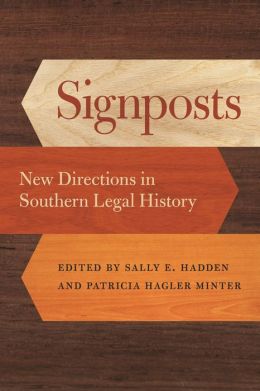
In Signposts, Sally E. Hadden and Patricia Hagler Minter have assembled seventeen essays, by both established and rising scholars, that showcase new directions in southern legal history across a wide range of topics, time periods, and locales. The essays will inspire today's scholars to dig even more deeply into the southern legal heritage, in much the same way that David Bodenhamer and James Ely's seminal 1984 work, Ambivalent Legacy, inspired an earlier generation to take up the study of southern legal history.
Contributors to Signposts explore a wide range of subjects related to southern constitutional and legal thought, including real and personal property, civil rights, higher education, gender, secession, reapportionment, prohibition, lynching, legal institutions such as the grand jury, and conflicts between bench and bar. A number of the essayists are concerned with transatlantic connections to southern law and with marginalized groups such as women and native peoples. Taken together, the essays in Signposts show us that understanding how law changes over time is essential to understanding the history of the South.A few blurbs:
"Constitutional and legal history converge comfortably in this welcome rethinking of the southern legal heritage. Signposts is a milestone in the emergence of a more encompassing vision of the legal and constitutional history of the South."
—William M. Wiecek, author of The Birth of the Modern Constitution: The United States Supreme Court, 1941-1953
"This collection is truly first rate, offering essays that plow new ground or offer fresh perspectives on more familiar topics. While the individual essays are more than worth the price of admission, together they offer rich insights into the ways law shaped and was shaped by southern society. Hadden and Minter have done an enormous service to the field of legal history by bringing this outstanding group of authors together in a volume that underscores the vitality of southern legal history and sets an ambitious agenda for future scholarship.—Donald G. Nieman, coeditor of Local Matters: Race, Crime, and Justice in the Nineteenth-Century SouthAfter the jump -- a table of contents. (I got a sneak peak through my OAH commenting gig):
Read more » (Read More..)
Law Day at the Law Library of Congress
 |
| Credit: ABA |
The Law Library explains that the program
will be held at 1 p.m. on Wednesday, May 1, in the Mumford Room, located on the sixth floor of the Library’s James Madison Building, 101 Independence Ave. S.E., Washington, D.C. The event is free and open to the public; tickets are not required.(Read More..)
Carrie Johnson, justice correspondent for National Public Radio, will moderate a panel discussion on the movement in America for civil and human rights and the impact it has had in promoting the ideal of equality under the law. . . . Distinguished panelists will include Sherrilyn Ifill, president and director-counsel for the, NAACP Legal Defense and Educational Fund, Inc.; Jeffrey Rosen, professor of law at The George Washington University and legal affairs editor of The New Republic; Risa L. Goluboff, professor of law and history at the University of Virginia and scholar in residence at the John W. Kluge Center in the Library of Congress; and Kirk Rascoe, director of Opportunity, Inclusiveness and Compliance at the Library of Congress.
Finkelman on the Proslavery Constitution and the Civil War
Paul Finkelman, Albany Law School, has posted How the Proslavery Constitution Led to the Civil War, forthcoming in the Rutgers Law Journal 43 (2013):405. Here is the abstract:
This article explores the proslavery nature of the US Constitution and the ways in which that Constitution set the country on the road to the Civil War. The article points out that under the Constitution it was impossible to end slavery. Even to this day, in 2013, it would be impossible to amend the Constitution if all 15 of the slave states (or now former slave states) opposed the amendment. This article was first presented a symposium on the Constitution and the Civil War at Rutgers Camden Law School.(Read More..)
Sharfstein and Stilt Win Guggenheims
.
Labels:
Fellowships Grants Honors and Awards
Congratulations to Daniel J. Sharfstein, Vanderbilt Law, and Kristen Stilt, Northwestern Law, on being named John Simon Guggenheim Memorial Foundation Fellows. The complete list of this year's fellows is here.
(Read More..)Pulitzer Prize to Devil in the Grove
.
Labels:
Fellowships Grants Honors and Awards

Among the finalists for the History Prize was Lincoln’s Code: The Laws of War in American History, by John Fabian Witt, “a striking work examining how orders issued by President Lincoln to govern conduct on battlefields and in prisons during the Civil War have shaped modern laws of armed conflict." (Read More..)
CFP: Religious Studies 50 Years after Schempp
.
Labels:
Conferences and Calls for Papers,
Religion
[We have the following call for papers.]
The Department of Religious Studies at Indiana University-Bloomington is hosting a conference entitled “Religious Studies 50 Years after Schempp: History, Institutions, Theory” the weekend of September 27-29, 2013.
Fifty years ago the Supreme Court of the United States announced its decision in Abington v Schempp, 374 U.S. 203 (1963). While the case before the Court concerned the constitutionality of mandatory Bible reading in Pennsylvania public schools, the opinions in the case have come to be understood as the authorizing texts for the academic study of religion in public colleges and universities across the U.S. and beyond. The Court wrote that while prescribing religious exercises in public schools violates the establishment clause of the First Amendment to the U.S. Constitution, “a study of comparative religion or the history of religion and its relationship to the advancement of civilization” could be said to be a necessary part of a complete education.
The years following the Schempp decision witnessed a flourishing of departments of religion in public colleges and universities and an intense conversation about the appropriate approach to the academic study of religion in the U.S. context. Now, fifty years later, the anniversary of the decision provides an occasion for an appraisal of Schempp’s role and for a broader assessment of the past, present, and future of the field of religious studies. This conference will explore the impact that Schempp may have had on the comparative and multi-disciplinary nature of the study of religion as well as other significant influences on shifts in the study of religion over that time.
We invite proposals for papers across the disciplines of religious studies. While Schempp provides a focal point for the conference, we invite conferees to propose 20-minute paper presentations that consider the broader history and phenomenology of the study of religion in the multiple locations in which such study takes place, private and public.
Three plenary speakers have been invited to focus our conversations:
Sarah Barringer Gordon, Arlin M. Adams Professor of Constitutional Law and Professor of History at the University of Pennsylvania Law School. Gordon is a widely recognized scholar and commentator on religion in American public life and the law of church and state.
Gerald J. Larson, Rabindranath Tagore Professor Emeritus of Indian Cultures and Civilization, Indiana University, Bloomington, and Professor Emeritus, Religious Studies, University of California, Santa Barbara. Larson, a prominent scholar of Indian religious traditions who helped to shape the study of religion at the University of Tennessee, UC Santa Barbara, and Indiana University, will offer reflections on the place of the study of Asian religions in the academic study of religion.
Charles H. Long, Emeritus Professor of Religious Studies at UC Santa Barbara, and former professor of religion at the University of Chicago, UNC Chapel Hill, Duke University, and Syracuse University. Long, a distinguished historian of religion and leading scholar in the study of American religion, had a direct influence on the development of the academic study of religion in the latter part of the twentieth century.
Applicants are invited to send a proposal with a title, a 300-word abstract, and a two-page CV to the following address by May 1, 2013. Applicants may submit their materials as Word attachments. Send to: Professor David Haberman, Department of Religious Studies, Sycamore 230, Indiana University, Bloomington, IN 47405; dhaberma@indiana.edu with a cc copy to kfrancoe@indiana.edu.
In order to keep track of numbers, we ask that attendees complete a brief registration form. Please download the form here.
Subscribe to:
Posts (Atom)